What does it mean to achieve at the highest level, while quietly carrying something heavy beneath the surface?
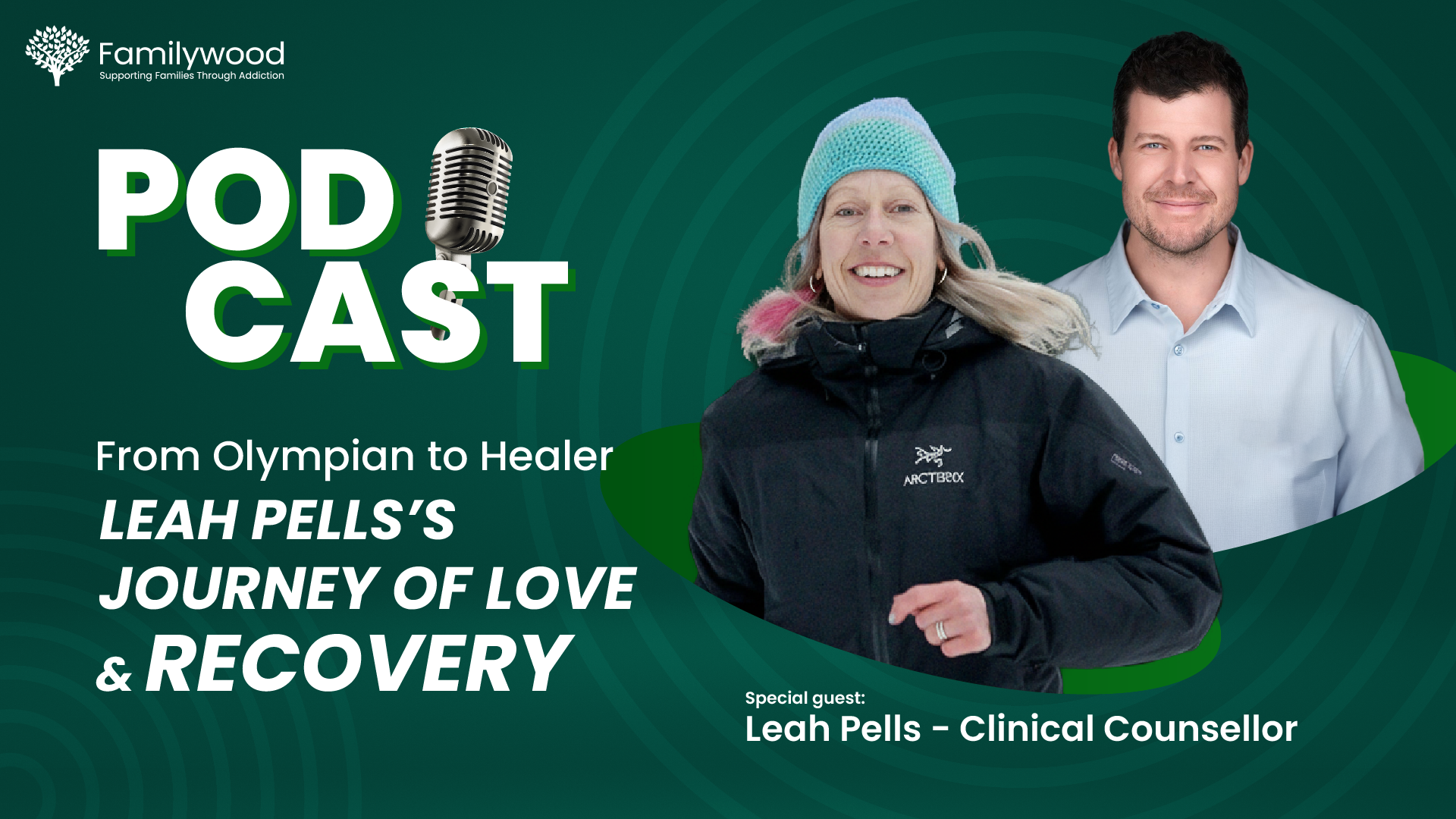
In this episode of the Familywood Podcast, Ross St. George sits down with clinical counsellor, Olympian, and author Leah Pells to explore a story that challenges the way we understand success, resilience, and the long-term impact of addiction in the family.
Leah’s accomplishments are remarkable. She competed as a three-time Olympian and became one of Canada’s most promising middle-distance runners. From the outside, her life reflected discipline, achievement, and excellence. However, behind those achievements was a childhood shaped by her mother’s alcoholism, where instability, secrecy, and emotional strain were part of everyday life.
This conversation moves beyond performance and into something far more human: what it means to grow up in a home where addiction is present, and how those early adaptations shape us long into adulthood.
When Achievement Becomes Survival
Leah describes running not as a pursuit of greatness, but as a refuge. As a child, it gave her something she could rely on when her home environment felt unpredictable. It was one of the few places where she could create a sense of control and internal steadiness.
“I could put my running shoes on and go run for hours… it was something I could do for myself.”
Over time, that coping strategy evolved into identity. What began as self-soothing became performance. Performance became validation. And validation became a way to feel safe.
This pattern is deeply familiar in families affected by addiction. Children often adapt by becoming highly capable and externally successful. They learn to anticipate needs, manage emotional environments, and perform at a high level, not simply out of ambition, but because it creates a sense of stability in an otherwise unstable system.
These adaptations are not flaws. They are intelligent responses to difficult circumstances. However, they often come at a cost, particularly when self-worth becomes tied to achievement.
The Role a Child Was Never Meant to Play
Leah speaks candidly about the responsibilities she took on at a young age. She was not only navigating her own development, but also stepping into a caretaking role within the household. She cleaned up after her mother, managed the environment as best she could, and attempted to keep things functioning.
Alongside this responsibility was an emotional burden that is common in these environments: shame.
“I felt like I was bad… like something about me was tarnished.”
Children rarely have the framework to understand addiction as an illness. Instead, they internalize what they observe. If something feels wrong in the home, it can begin to feel like something is wrong with them. This often leads to perfectionism, people-pleasing, and a deep drive to compensate for something that was never theirs to carry.
At the same time, many children develop a strong sense of responsibility for the parent. Leah describes the fear of leaving or stepping away, not because she wanted to stay in dysfunction, but because she worried about what would happen to her mother if she didn’t remain present.
“If I leave… who’s going to take care of them?”
This belief can persist well into adulthood, shaping decisions, relationships, and the ability to establish boundaries.
The Gap Between External Success and Internal Experience
One of the most striking elements of Leah’s story is the contrast between how her life appeared and how it felt internally. From the outside, her accomplishments suggested confidence, strength, and fulfillment. Internally, what she remembers most clearly is not pride, but relief.
“I was relieved… I can do this. I can have a good life.”
Relief suggests something important. It reflects the experience of someone who has been holding tension, uncertainty, or fear for a long time, and finally feels a momentary release. This distinction highlights a reality that many high-functioning individuals experience: success can coexist with unresolved emotional pain.
Achievement can provide structure, purpose, and even temporary stability, but it does not automatically heal what was formed in early relational environments.
Understanding Addiction Through a Different Lens
A key theme throughout the conversation is the need to move beyond oversimplified explanations of addiction and mental health. Leah emphasizes that while biological factors can play a role, reducing complex human experiences to a single cause often misses the broader context.
Addiction, in her view, is not something people choose in a vacuum. It is often a response to underlying pain, trauma, or difficulty regulating emotional experience. Substances can initially provide relief, but over time they create additional layers of difficulty.
This perspective shifts the conversation from judgment to understanding. Rather than asking why someone continues to engage in harmful behavior, it invites a deeper question: what is this person trying to cope with, and what has shaped their current patterns?
The Work of Healing
Leah’s path toward healing did not begin with a structured plan or a defined outcome. It began with reflection. What eventually became her memoir started as journaling, an attempt to understand her experiences and the patterns she noticed in her life.
“It started as a way for me to try to heal and understand what had happened.”
This is often how meaningful change begins. Not with certainty, but with curiosity. Not with answers, but with a willingness to explore.
Through this process, Leah came to recognize both the impact of her upbringing and her responsibility moving forward. One of the most important shifts she describes is the transition from trying to fix or manage her mother’s experience to taking ownership of her own well-being.
Love, Boundaries, and Complexity
One of the most nuanced and powerful parts of this conversation is Leah’s perspective on love. She is clear that her mother’s addiction did not mean there was an absence of love. At the same time, love did not eliminate the need for boundaries.
“I loved my mom and I know that my mom loved me… she was just really unwell.”
As an adult, Leah established a boundary that allowed both truths to coexist. She could care deeply about her mother while also recognizing that being around her during periods of drinking was not healthy.
This reflects a central challenge for many families: learning to hold two realities at once. It is possible to love someone and still choose distance. It is possible to care and still prioritize one’s own well-being.
Learning to Live with Discomfort
Another key theme is the role of discomfort in the healing process. Many individuals affected by addiction develop strategies aimed at reducing or eliminating distress, whether through control, avoidance, or over-functioning.
Leah highlights that discomfort is not something that can be avoided entirely. Instead, healing involves learning how to tolerate difficult emotions while continuing to move forward.
“We can’t avoid discomfort… what can I do to tolerate it while still living my life?”
This is often one of the most challenging shifts. It requires letting go of the belief that things must be resolved before one can feel okay, and instead developing the capacity to carry uncertainty, grief, and fear without being overwhelmed by them.
Books Discussed in This Episode
Leah’s memoir, Not About the Medal, offers a deeply personal account of growing up in a home impacted by addiction while pursuing elite athletic performance. The book explores themes of perfectionism, identity, and healing, and provides insight into the internal experience behind external success.
The conversation also touches on Chemically Imbalanced by Dr. Joanna Moncrieff, which challenges the idea that mental health conditions can be explained solely by chemical imbalances. The book encourages a broader understanding of psychological distress, emphasizing the role of life experiences, context, and environment.
Trauma Support for First Responders
Leah also discusses her involvement with the Loon Lake First Responder Resiliency Program, a retreat-based initiative designed to support individuals experiencing trauma, particularly those in high-stress professions such as firefighting and policing.
The program brings participants together in a structured, supportive environment where they can begin to process their experiences, connect with others who share similar challenges, and develop foundational skills for healing. Importantly, it is positioned as a starting point, helping individuals transition into longer-term therapeutic work.
A Final Reflection
When asked what stands out most in her life, Leah’s response centers on something simple yet profound: the enduring presence of love.
“The enduring ability of love.”
Despite the instability, the pain, and the complexity of her upbringing, love remained a constant thread. At the same time, her story makes it clear that love alone is not enough to sustain well-being.
Healing requires boundaries, self-awareness, and support. It requires a willingness to look honestly at what has been carried and to make intentional choices about what is carried forward.
For individuals and families affected by addiction, this work is not easy. However, it is possible. And it often begins in the same place Leah’s did, with a willingness to pause, reflect, and ask a different set of questions.