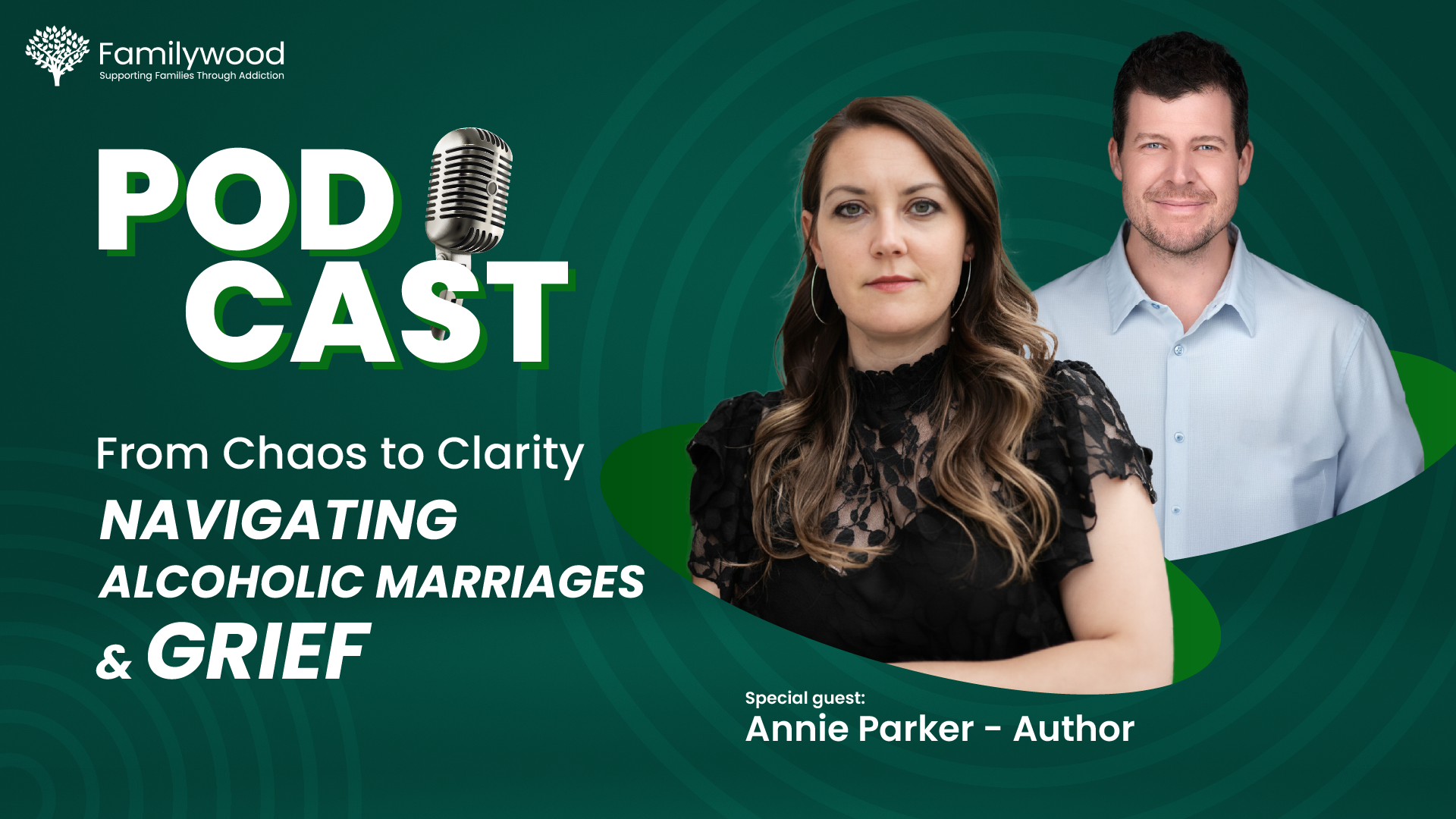
Familywood Podcast ft. @anniethesafeparent
There is a kind of grief that most people don’t recognize.
It doesn’t begin with death.
It begins slowly, inside a relationship that is changing in ways you didn’t choose.
It’s the grief of loving someone who is still alive, but no longer able to show up in the ways you need.
In this episode of the Familywood Podcast, Annie Parker, known as Annie the Safe Parent with 120K+ followers (@anniethesafeparent on Instragram), gives language to that experience. Her story reflects what so many spouses and parents live through quietly: the confusion, the isolation, and the slow realization that addiction is no longer a part of the family system. It has become the center of it.
When You Realize It’s Not Just a Problem
For many families, awareness doesn’t come all at once. It builds over time.
But sometimes, there is a moment.
For Annie, it was walking into her home and seeing her husband holding their infant child while drinking vodka from a water bottle. That was the shift. Not just concern, but clarity.
Something fundamental had changed.
From there, life became increasingly unstable. Hospital visits, accidents, emotional volatility, and unpredictability became part of daily life. What had once been a partnership slowly turned into crisis management.
And like many people in this position, she didn’t talk about it. She carried it alone.
The Invisible Load
One of the most misunderstood parts of living with addiction is how invisible it can be.
On the outside, Annie was functioning. She was a teacher, responsible for other people’s children every day. She was a mother to her own young kids. She kept showing up.
Inside, she was navigating chaos.
She describes this as “robotting” through life. Turning on when needed. Holding everything together. Then doing it again the next day.
This is not uncommon.
When addiction enters a family system, one person often absorbs the instability so the system can continue to function. Over time, that role becomes exhausting, isolating, and unsustainable.
When the Focus Shifts
At some point, the question changes.
In the early stages, many spouses are asking:
How do I help them?
But over time, especially when children are involved, that question becomes something else: How do I protect what still can be protected?
For Annie, that shift came through her children.
She began to notice anxiety, fear, and subtle changes in their behaviour. One child trying to stay home to care for his father. Another stepping into a role that was never meant for him. These weren’t isolated moments. They were signs of a system under strain.
One interaction made it undeniable. Her young son placed his hand on hers and told her he would help.
In that moment, something became clear.
This was no longer just about her husband’s addiction. It was about the environment her children were growing up in.
And eventually, the internal calculation changed. Staying was no longer the safer option. Leaving was.
The Role of the Safe Parent
In homes affected by addiction, there is often one person who becomes the stabilizing force.
Annie describes this as the “safe parent.”
Not perfect. Not unaffected. But consistent enough to anchor the system when everything else feels unpredictable.
This role involves difficult, often conflicting responsibilities. Holding boundaries while still caring. Managing emotional reactions while under stress. Trying to create safety for children while navigating your own exhaustion.
Importantly, Annie is honest about her own experience in this role. She wasn’t calm all the time. She wasn’t unaffected. She describes being angry around her children, even if not at them.
What changed was not perfection, but awareness.
And from that awareness came repair, communication, and eventually, growth.
The Research on Grief in Families Affected by Addiction
In the episode, we discussed a study exploring something many families feel but rarely name: grief while the person is still alive:
https://pmc.ncbi.nlm.nih.gov/articles/PMC7691893/
The research highlights that spouses and parents often experience ongoing loss, not from death, but from the gradual change in the relationship. The loss of trust, stability, and the future they once imagined.
Because this doesn’t fit the traditional definition of grief, it often goes unrecognized. Instead, it shows up as anxiety, exhaustion, or constant emotional strain.
Importantly, the study reframes family members not as “enablers,” but as caregivers navigating chronic stress.
That shift matters.
When grief is named, it can begin to be understood and processed. And for many families, that’s where change starts.
Naming the Grief
One of the most important themes in this conversation is grief.
Not after loss, but during it.
Grief for the relationship that no longer exists in the same way.
Grief for the future that was expected but is no longer realistic.
Grief for the version of a partner or parent that addiction has altered.
This type of grief is often overlooked because it doesn’t fit the traditional narrative. The person is still there. The relationship still technically exists. But something essential has changed.
Many spouses are labeled in ways that reinforce shame. Terms like codependent or enabling are often used without acknowledging the reality of what they are doing.
Caring. Managing. Holding things together.
Annie reframes this clearly. These individuals are not simply enabling. In many ways, they are functioning as caregivers.
And caregivers grieve.
Why Leaving Is So Complicated
From the outside, it can be easy to ask why someone didn’t leave sooner.
From the inside, the answer is rarely simple.
There are financial realities. Emotional attachments. Fear of what will happen if you leave. Fear of what might happen to your children if you stay. Legal uncertainties. Exhaustion.
And underneath all of it, there is often hope.
Hope that things will change.
Hope that the person underneath the addiction will come back.
Annie’s reflection that she would have left sooner is not a statement of clarity alone. It is a reflection shaped by everything she now understands about the situation she was in.
What Helped
Healing did not happen in isolation.
A key part of Annie’s story is the role of specialized support, particularly grief-informed therapy that understood both addiction and its impact on families.
This created space for something that many families never experience: open communication.
It allowed her to acknowledge her own impact, to repair with her children, and to build a different kind of relationship moving forward. One based not on perfection, but on honesty, empathy, and accountability.
Her children are not unaffected by what they experienced. She is clear about that.
But they are supported. They are aware. And they are moving forward in a way that reflects the work that has been done.
What She Would Say Now
When asked what she would say to her past self, Annie’s answer was simple.
Keep going.
And keep your children at the forefront of your decisions.
There is weight in that.
Because continuing in these situations often requires more strength than leaving. And making decisions that balance your needs with your children’s needs is rarely straightforward.
If This Feels Familiar
If you recognize yourself in any part of this, it’s important to understand something:
What you are experiencing makes sense.
The confusion, the exhaustion, the hypervigilance, the grief. These are not signs that something is wrong with you. They are responses to a system that is under strain.
And you don’t have to navigate that alone.
Annie’s Books and the Kind of Support Many Families Actually Need
Part of what makes Annie’s work resonate is that it didn’t come from theory first. It came from lived experience.
On the podcast, we talked through her three books as a kind of progression, each meeting families at a different point in their journey.
Her first book, I Did Not Kill My Husband, But I Almost Killed Myself, is raw. It was written in the early stages of grief, not as a polished resource, but as an honest account of what it feels like to love someone through addiction. It gives language to experiences that many spouses carry but struggle to articulate, including the confusion, the guilt, and the slow loss that happens long before anything ends.
Her second book, A Year of Support for the Alcoholic’s Spouse, shifts into something more structured. It’s designed for people who don’t have the time, energy, or financial capacity to access consistent therapy. It offers small, manageable moments of support, something to return to when everything feels overwhelming. This reflects a reality we see often: many families are trying to hold everything together while having very little access to care.
Her third book, Above All Else, is where her framework becomes most clear. This is where she names the role of the “safe parent” and focuses on protecting children, creating stability, and making decisions that prioritize long-term wellbeing, even when those decisions are incredibly difficult.
What stands out across all three is not just the content, but the intention. Annie created what she needed when she was in it. And that’s often what families are actually looking for. Not just information, but something that understands the emotional reality of their situation.
The Role of Grief Support: Why the Right Fit Matters
We also spoke about a resource that played a critical role in Annie’s healing: Heartlinks Grief Center.
After her husband passed, Annie reached a point where she didn’t know how to support her children through their grief. Their anxiety was rising, and the impact of everything they had lived through was becoming more visible. She reached out for help, and Heartlinks responded immediately, providing both individual and family support.
What made the difference wasn’t just access. It was fit.
The therapist helped them do what many families never get the chance to do: communicate openly, take accountability, and begin repairing the relational impact of addiction and loss.
Just as importantly, the support was accessible. Services were offered regardless of ability to pay, which removed a major barrier at a time when resources were already stretched.
This reflects something we see consistently:
The right support, at the right time, with the right fit, can change the trajectory of an entire family.
Final Thought
Addiction doesn’t just impact an individual.
It reorganizes the entire family.
But with the right support, awareness, and shifts in how the system operates, healing can begin to reorganize it as well.