When addiction enters a family, the suffering rarely belongs to just one person.
Parents lose sleep. Spouses become hypervigilant. Adult children carry resentment, fear, guilt, and confusion. Siblings begin walking on eggshells. Family systems slowly reorganize around unpredictability, chaos, and survival.
Yet despite the enormous impact addiction has on families, many people continue to suffer quietly and alone.
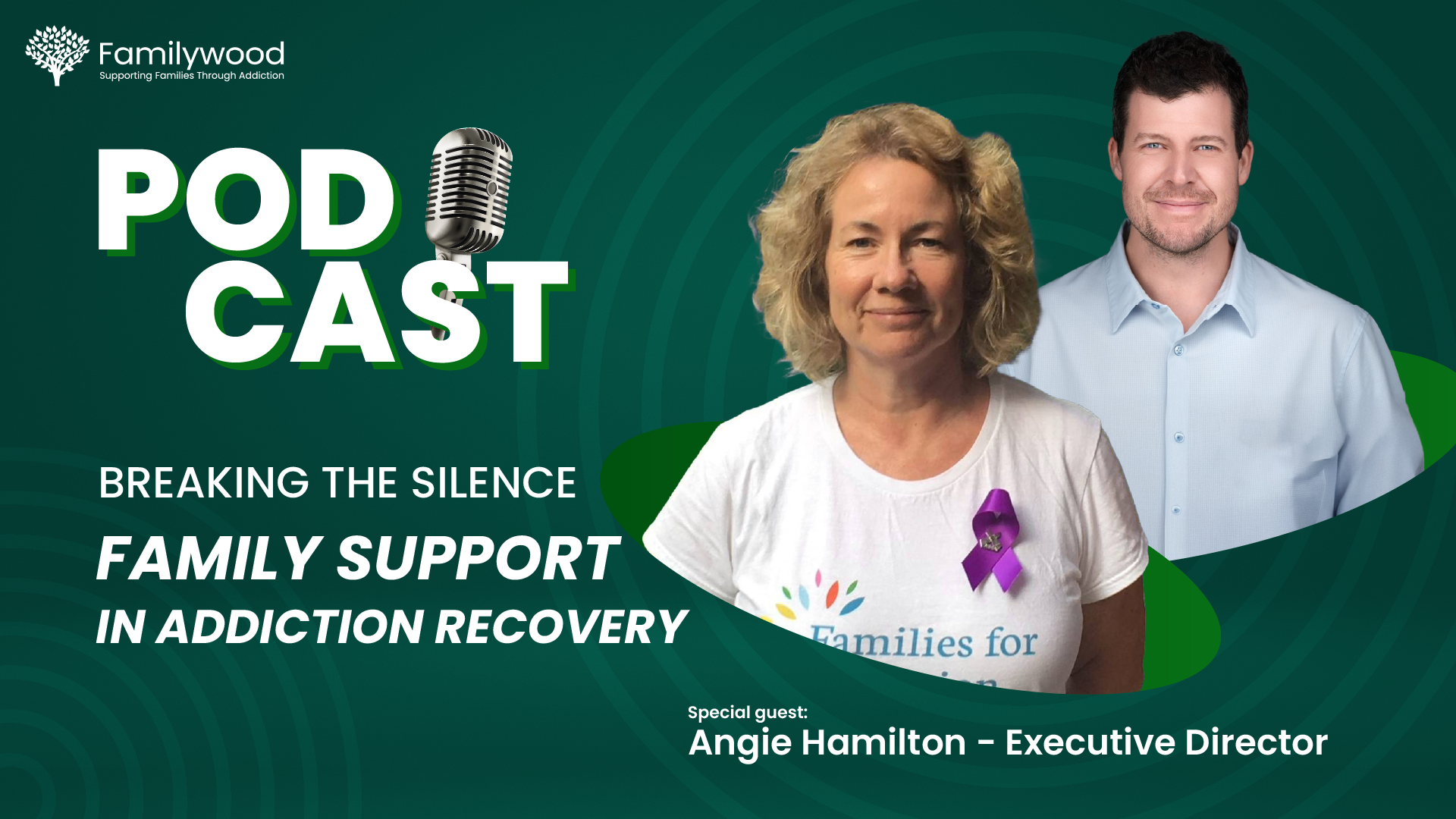
In a recent episode of the Familywood Podcast, I sat down with Angie Hamilton, Executive Director of Families for Addiction Recovery (FAR), to talk about one of the most overlooked parts of addiction care in Canada.
The stigma families carry.
For Angie, this work is deeply personal.
She grew up with addiction in her family and later experienced it again as a mother when her son developed severe substance use challenges.
“I grew up with addiction,” she shared. “And I think I’m retiring or going out with addiction.”
Like many parents, Angie found herself navigating fear, confusion, helplessness, and a system that offered very little support for families.
Rather than staying stuck in despair, she helped co-found Families for Addiction Recovery, a Canadian charity that provides free peer support, education, and advocacy for families affected by addiction.
The Hidden Shame Families Carry
Perhaps one of the most painful realities for families affected by addiction is the shame. Parents often quietly wonder: What did I do wrong? How did I cause this? What should I have done differently?
According to Angie, this self-blame is one of the heaviest burdens families carry.
There remains a quiet but powerful societal belief that if someone develops an addiction, somebody must be to blame. Often, that blame lands on parents, spouses, or family systems.
“If you were a good parent,” the thinking goes, “your child would not be struggling.”
It is a cruel narrative.
At Familywood, we hear versions of this self-blame almost every day. Parents replay decisions from ten years ago. Spouses question whether they enabled too much or not enough. Adult children wonder whether they somehow failed someone they love.
The truth is much more complicated than blame.
Addiction is influenced by genetics, trauma, attachment patterns, mental health, environment, stress, neurobiology, and social exposure. Even highly stable, loving, deeply committed families can experience severe substance use in someone they love.
As Angie pointed out in our conversation, believing addiction only happens to “other families” can feel strangely comforting because it creates the illusion of control. If good parenting guarantees safety, perhaps we can avoid the pain.
Unfortunately, addiction does not work that way.
“You Didn’t Cause It, You Can’t Control It, and You Can’t Cure It”
For many families, one of the most relieving concepts comes from Al-Anon’s well-known “Three C’s”: you did not cause it, you cannot control it, and you cannot cure it.
These words matter because families often carry an enormous sense of responsibility for outcomes that are ultimately outside of their control. Many parents and spouses quietly believe that if they could just say the perfect thing, create the perfect consequence, or love hard enough, things would finally change.
At Familywood, we often remind families of something similar. You cannot love someone into recovery. You cannot logic someone into recovery. And you cannot force readiness where it does not yet exist.
Many people in long-term recovery have experienced profound suffering without relapsing. Others continue using despite devastating losses, broken relationships, financial ruin, or severe health consequences. A loved one’s continued use is not proof that you failed.
At the same time, Angie introduced an important nuance that deeply resonates with us at Familywood.
Families are not powerless.
This is where her perspective differs somewhat from traditional recovery models.
“We don’t think we’re powerless,” Angie shared. “We don’t think we control the outcome. We don’t think we control them. We are not powerless because we get to control us.”
That distinction matters.
Families cannot control another person’s addiction. But they can learn how to communicate more effectively, strengthen boundaries, regulate their own emotional responses, and stop patterns that unintentionally maintain chaos. Families do not control outcomes, but families absolutely matter.
Why Families Wait Too Long to Reach Out for Support
One of the most important messages Angie shared was simple.
Families wait too long to get help.
Many people believe counselling or support should only begin once the loved one is ready for treatment.
“My loved one is the one with the problem,” families often think. “Why would I get help?”
But addiction impacts entire family systems.
Over time, family members commonly experience anxiety, depression, panic, insomnia, chronic stress, hypervigilance, emotional exhaustion, people pleasing, and relationship burnout.
Many describe feeling like they are constantly waiting for the next crisis.
The next phone call. The next relapse. The next emergency. The next lie. The next disappearance.
Over time, families begin losing themselves.
We often hear spouses say, “I do not even know who I am anymore.”
Parents tell us they have become consumed by worry. Adult children describe growing resentment while simultaneously feeling crushing guilt.
The emotional toll is real.
Support is not just for the person using substances.
Support is for the people trying desperately to survive beside it.
Families Do Not Need to Suffer in Silence
One moment from my conversation with Angie stayed with me.
She shared that families have told her, “You are the only person I can talk to.”
That breaks her heart.
And honestly, it breaks mine too.
Because addiction thrives in silence. Shame thrives in silence. Fear thrives in silence.
Families often hide what is happening because they fear judgment, criticism, or misunderstanding from others. They may feel embarrassed, ashamed, or unsure whether anyone will truly understand what they are going through.
But suffering alone almost always makes things worse.
The good news is that support exists.
Some families find healing through peer support communities. Others benefit from recovery-informed counselling. Many find strength through a combination of both.
What matters most is reaching out.
Sooner than you think you need to.
You do not have to wait until things completely fall apart. You do not need to wait until there is another crisis.
You do not need to carry this alone.
Families for Addiction Recovery: A Lifeline for Families
One of the reasons Angie co-founded Families for Addiction Recovery (FAR) was simple.
Families were not getting the support they needed.
As a parent navigating her son’s substance use, Angie quickly realized there were very few places for families to turn. There were limited resources, little guidance, and almost no recognition that addiction affects entire family systems, not just the individual using substances.
Today, FAR provides free support for families across Canada through peer support groups, a family helpline, and one-on-one peer support matching for parents and family members affected by addiction.
What makes FAR particularly unique is that the organization was built by people who have lived this experience themselves. Families are often connected with others who understand the chaos, fear, heartbreak, and confusion that can come with loving someone struggling with severe substance use.
As Angie shared in our conversation, many families feel isolated and misunderstood. Some have even told her, “You are the only person I can talk to.”
That reality highlights an important truth.
Families need support too.
And often, they need it much sooner than they realize.
The Difficult Conversation Around Mandatory Treatment
One of the more complex topics we discussed on the podcast was involuntary or mandatory treatment.
It is a deeply emotional and often polarizing issue in Canada. Families, clinicians, policymakers, and advocacy groups frequently disagree on when, or if, someone should be compelled into treatment.
Angie and the research team at Toronto Metropolitan University interviewed 87 family members affected by severe substance use. Many had experienced profound consequences including homelessness, criminal involvement, severe mental health deterioration, repeated overdoses, suicidality, and in some cases, the death of a loved one.
For Angie, the conversation about involuntary treatment is ultimately about severe illness and harm reduction.
Her perspective is not that everyone struggling with substance use should be forced into treatment. Rather, she believes there are situations where severe addiction significantly impairs a person’s ability to make informed decisions about their own care, particularly when there is serious risk of harm to themselves or others.
Families living through severe addiction often have what Angie described as a “front row seat” to the devastation. They witness the cognitive decline, loss of functioning, repeated crises, and escalating risks that may not always be visible to systems of care.
At the same time, Angie emphasized something important.
Mandatory treatment should never distract from the need for accessible treatment on demand for those who are actively seeking help.
In her view, Canada must do both. We need more accessible treatment for people who want help, while also having compassionate pathways for intervention when severe illness has profoundly impaired judgment and safety.
Whether people agree or disagree with involuntary treatment, one thing became very clear during our conversation.
Families are desperate for better options.
Too many feel trapped between watching someone deteriorate and being told there is nothing they can do.
For many families, that helplessness can feel unbearable.