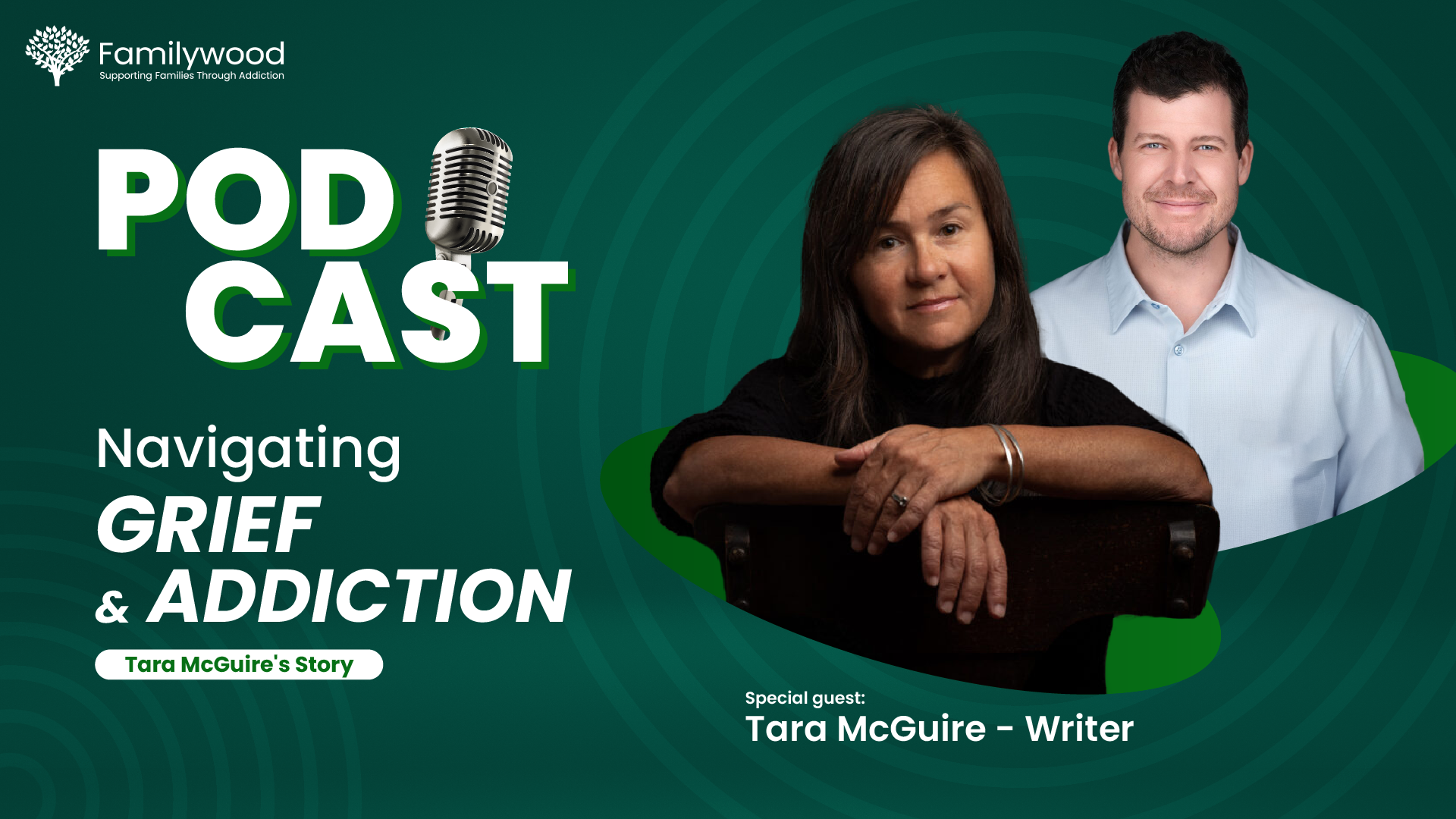
When addiction enters a family, it rarely arrives quietly. It reshapes relationships, distorts communication, and often leaves families carrying fear and emotional exhaustion that is difficult to describe. In this episode of the Familywood Podcast, Ross St. George sits down with Canadian author Tara McGuire to explore what it means to lose a child to substance use and what families need to understand in the reality of today’s overdose crisis.
A Mother’s Story: Loss, Silence, and Finding Language Again
Tara McGuire’s story begins in a place many families will recognize. There is love, concern, and the slow realization that something is not right. Her son Holden died from an accidental alcohol and heroin overdose shortly after she returned home from a family trip.
What followed was not just grief, but disorientation. Tara describes losing her voice entirely in the months after his death. Conversations became impossible. Memory itself felt fragmented.
Writing became her way back. It started with poetry that she describes as imperfect, but it opened a door. Not because it made anything easier, but because it allowed her to sit with what could not be avoided.
📖 Holden, After and Before: A Book That Brings Humanity Back to Addiction
At the center of this conversation is Tara’s book, Holden, After and Before. It is a deeply original work that blends memoir with reconstructed narrative. Instead of simply recounting events, Tara chose to write Holden as alive. He moves through the story in present tense, with personality, humour, and complexity.
This approach changes how the reader experiences addiction. It is no longer reduced to behaviors or outcomes. The reader is brought back to the person underneath. A son. A friend. Someone sensitive, curious, and deeply human.
Tara emphasizes something that many families feel but struggle to say out loud. Good people die from substance use disorder. In many cases, those who struggle are highly sensitive and deeply affected by the world around them. Substance use begins to make more sense in that context. It is not something to condone, but it is something to understand.
The Dangerous Shift: Why “Rock Bottom” No Longer Applies
One of the most important themes in this episode is how the landscape of addiction has changed. Families were once told to step back, to stop enabling, and to let their loved one hit rock bottom. The belief was that things had to get worse before they could get better.
That belief no longer holds in today’s environment.
With fentanyl and a toxic drug supply, rock bottom is often death.
Tara reflects on advice she once received that encouraged distance. In hindsight, it blurred the line between enabling and support. What is becoming clearer, both clinically and through lived experience, is that connection can be protective. Families do not need to accept harmful behavior, but where there is capacity, staying engaged can save a life.
Guilt, Parenting, and the Stories Families Carry
Few experiences lead to more self-questioning than losing a child. Tara speaks openly about guilt and regret. She also offers a clear and grounded perspective. Guilt has no place in parenting.
Parents are navigating complex situations without a clear guide. Decisions are often made under pressure, fear, and conflicting advice. Guilt may feel natural, but it does not help the parent or the person struggling.
Addiction already carries significant shame. Adding more does not create change. It often deepens the cycle.
Safe Injection Sites: What Tara Saw Firsthand
A powerful part of this conversation is Tara’s experience visiting a safe injection site while researching her book, through her connection with the Vancouver Overdose Prevention Society.
What she encountered challenged common assumptions.
She met people who were funny, creative, and deeply human. People who were not trying to die.
Safe injection sites are often misunderstood. They do not provide drugs. Instead, they offer testing, clean supplies, medical supervision, and a place where people can use without dying alone. They also reduce other risks such as infection, unsafe conditions, and vulnerability to violence.
Most importantly, they create connection.
These sites represent an opportunity. Each interaction is a chance to move toward support, treatment, or simply a moment of dignity.
Timing Matters: When Someone Is Ready for Help
Tara highlights something that families and clinicians both recognize. Readiness does not last forever.
When someone becomes open to change, support needs to be immediate. Delays or barriers can mean the opportunity disappears.
This reflects a broader system challenge. While progress has been made, gaps still exist between crisis, readiness, and access to care.
What Families Can Hold Onto
Despite everything, Tara offers something many families need to hear. The person you love is still there. Their qualities have not disappeared. They may be hidden, but they are not gone.
She also brings attention to something simple but meaningful. Connection does not always need to be deep or structured. It can be found in everyday moments. Sharing food, spending time outside, or simply being present can matter more than expected.